

Device-supported workflows for clinical care beyond the clinic.
Ambulant+ focuses on a defined Contactless Medicine device ecosystem — Health Monitor, Digital Stethoscope, HD Otoscope and NexRing — each mapped to clinician-led workflows, patient context and governance boundaries.
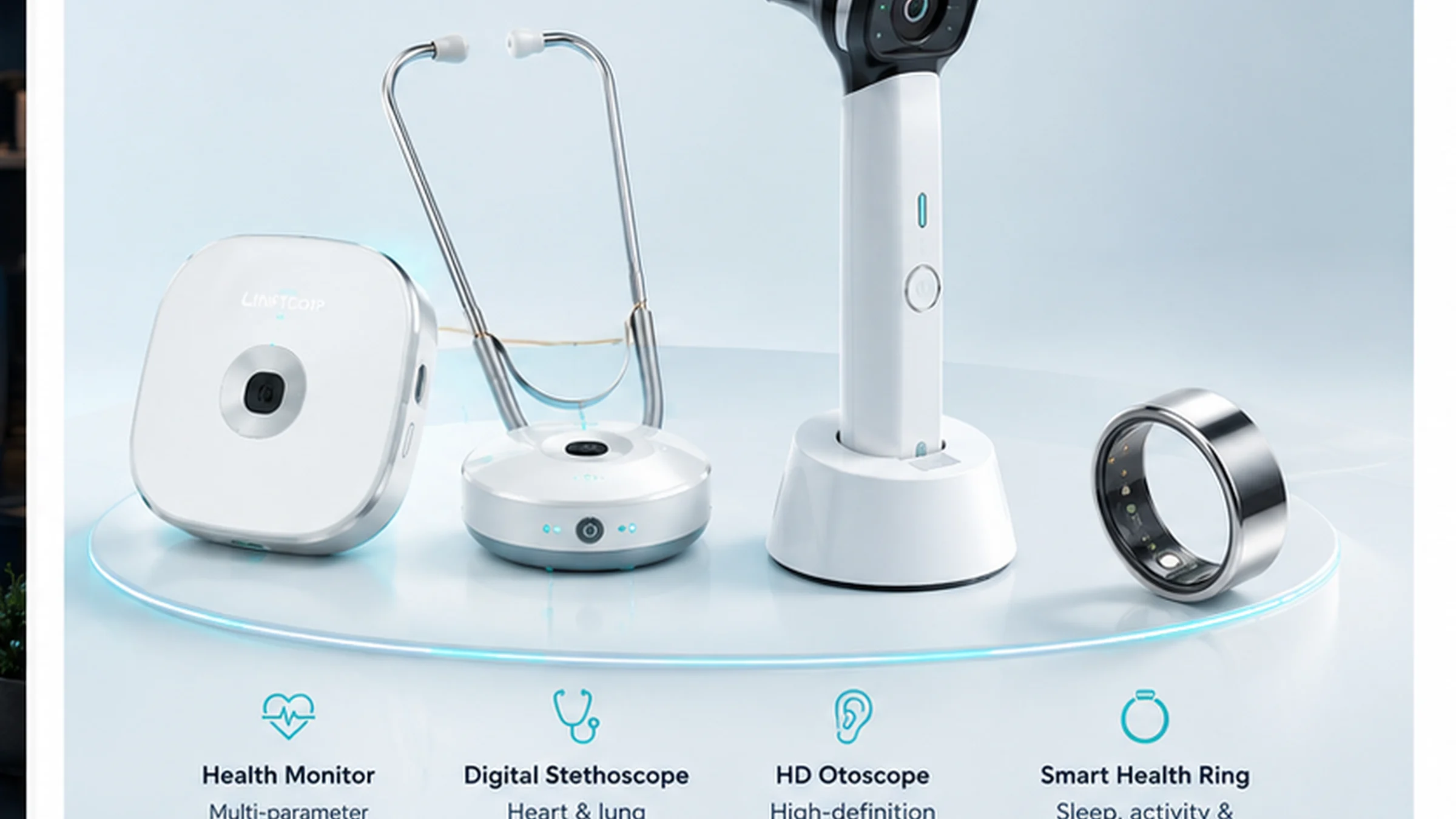
Contactless Medicine closes the clinical-context gap in ordinary telemedicine.
Standard telemedicine is often limited to video, voice and patient self-reporting. Ambulant+ extends remote care with supported IoMT workflows so clinicians can review vitals, auscultation, visual inspection and longitudinal trends where appropriate.
Structured signal layer for clinician-led interpretation.
Structured signal layer for clinician-led interpretation.
Structured signal layer for clinician-led interpretation.
Structured signal layer for clinician-led interpretation.
Four supported device pathways. No wearable sprawl.
Ambulant+ focuses on a disciplined device scope: Health Monitor, Digital Stethoscope, HD Otoscope and NexRing. Each device maps to a specific care workflow and clinical boundary.
Health Monitor
Blood pressure, SpO₂, temperature, blood glucose, heart rate and ECG workflows.
Digital Stethoscope
Heart and lung auscultation capture, playback, review and sharing.
HD Otoscope
Ear-imaging capture and review for supported remote assessment workflows.
NexRing
Longitudinal signals for sleep, readiness, recovery trends and supported telemetry.
Four device categories. One governed clinical workflow.
Ambulant+ avoids unsupported wearable sprawl. Each supported device category has a clear purpose inside the care journey.
Health Monitor
The Health Monitor supports structured capture of core physiological parameters so clinicians can review objective context during appropriate remote-care journeys.
Digital Stethoscope
The Digital Stethoscope supports capture, playback and clinician review of heart and lung sounds in device-supported virtual consultations.
HD Otoscope
The HD Otoscope supports image and video capture for ear assessment and selected visual inspection workflows where remote review is appropriate.
NexRing
NexRing supports longitudinal wellness and readiness signals, helping Ambulant+ understand how a patient’s physiology changes beyond a single appointment.
The difference is not the video call. It is the clinical input layer.
Contactless Medicine is designed around the inputs that are usually missing from ordinary remote consultations: objective vitals, remote examination tools, trend context, diagnostics and fulfilment coordination.
Often unavailable or self-reported
Measured through supported Health Monitor workflows
Usually unavailable
Captured through Digital Stethoscope workflows
Limited by ordinary camera quality
Supported by HD Otoscope image and video workflows
Rarely available in structured form
Supported by NexRing and connected patient records
Often separated from fulfilment and diagnostics
Connected to MedReach, CarePort and InsightCore pathways
Signals become useful when the workflow is governed.
Ambulant+ treats device data as structured context for appropriate care workflows, not as standalone automatic diagnosis.
Prepare
Patient profile, consent, device readiness and care context are prepared before review.
Pair
Supported devices are connected through approved setup pathways.
Capture
Vitals, auscultation, otoscopy or longitudinal signals are collected depending on the device.
Review
Readings are presented in a structured patient or clinician workspace for interpretation.
Document
Relevant signals can be attached to care notes, reports or follow-up actions where appropriate.
Escalate
Patients are directed to urgent or in-person care where device-supported remote review is not sufficient.
What patients gain
What clinicians gain
Device confidence must stay tied to exact documentation, jurisdiction and intended use.
Ambulant+ can present device certification and registration information where documentation supports it, while avoiding blanket claims that could misrepresent the regulatory position of a device, module or market.
Enter the right Ambulant+ workspace.
Ambulant+ separates public information from protected workspaces, giving patients, clinicians, pharmacies, diagnostics teams, clients and administrators a role-appropriate route into the platform.